
Puget Sound Native Tree
Botanical Garden
The Puget Sound region of Washington State is a contrast in worlds. How can it be a young forest filled with ancient trees?
Think of that statement. The forests of the Amazon basin were intact for over 20 million years, perhaps as long as 40 million. The Columbia River system has been flowing for over 20 million years, perhaps as long as 40 million years. They existed before Mount Rainier (less than 3 million), before the Cascade Mountains were raised, EVEN before the Olympic Mountains rose from the sea (yes, the Olympic Mountains were once part of the North American continental shelf and ocean terraine under the ocean surface).
Until 20 thousand years ago, much of Puget Sound and all of Bainbridge Island was under thousands of feet of rock (solid ice) of the glaciers of the last ice age. And those ice ages scraped and tore up the landscape over and over for two million years.
The mature Puget Sound forests did not exist until 10,000 years ago. And they no longer exist today.
It has been totally eliminated in the lowlands, with perhaps a large tree here or there.
Dolphin Place has a very small slice of what has been. Medium sized examples of the decedents of ancient trees and some of the understory that existed with them. Breeding populations, not of bears and elk and cougars, but perhaps enough for Douglas Squirrels, Ensatina eschscholtzii oregonensis salamanders, and yellow spotted millipedes.
Dolphin Place Open Space contains 100-200 year old examples of the major ingredients of those original ancestral giants. The site includes all the dominate species that existed before the logging centuries: the big three: Douglas Fir, Red Cedar, Hemlock; important players: Grand Fir and Yew.
Of the most common major conifers we lack only Sitka Spruce and White Pine (our Pine died in a drought in 1976) as examples of a mature local specimens. These two have been reintroduced to the property for people to enjoy.
Dolphin Place Original Conifers
All photos taken at Puget Sound Native Tree Garden unless otherwise noted
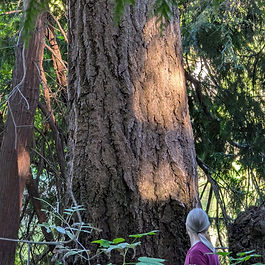


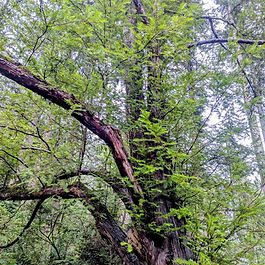

7- The strong and lightweight Sika Spruce wood allowed: Howard Hughes to build the largest airplane in the world; Bill Boeing to build thousands of WW-II warplanes, and the US navy to make fairings for their missiles
Sitka Spruce
I'm a paragraph. Click here to add your own text and edit me. It's easy.

Looking for land within Puget Sound that contained a significant forest and variety, we bought the property that became Dolphin Place Open Space after a two year search in 1973.
After scrambling through the brush, which obscured the view after only ten or twenty feet, the attribute that was most soul satisfying was the size of the second growth forest trees that appeared after pushing aside the understory.
Only after acquiring the property did we discover the wealth of what was here. All the major lower Puget Sound conifers were represented in mature form:
The Big 4:
-
Douglas Fir
-
Western Red Cedar
-
Western Hemlock
-
Grand Fir
Douglas Fir:
-
Strongest wood
-
Most drought and fire resistant
-
Tallest
-
Long Lived
-
Rot resistant
Western Red Cedar
-
Most rot resistant live wood
-
Most water saturated soil tolerant
-
Largest girth
-
Shade tolerant
-
Capable of regeneration and layering
-
Weakest wood
-
Longest lived
Western Hemlock
-
Most shade tolerant
-
Capable of germination in the forest shade
-
Capable of sprouting in moss nurse logs
-
In undisturbed forests, becomes the climax tree
Grand Fir:
Grows along side Douglas Fir in Puget Sound. Not quite as tall, not quite as fire resistant, not quite as long lived, but within the environment of the Puget Sound basin, is almost as common as the Doug.
Next up: two other conifers found naturally at the Puget Sound Native Tree Botanical Garden when
the site was established in 1973
-
Western White Pine
-
Pacific Yew
Western White Pine: Can grow in both dry and wet soils, and mixes further across the environments of Douglas Firs and Red Cedars, but is not as common. Most in the region killed off by a European disease in the early 1900's.
Pacific Yew: Grows slowly in the understory of the big forest. A Republican kind of tree: lots of sun, grows slowly, mostly shade, grows slowly. Slow and steady allows it to withstand change, which does occur over the centuries due to big storm blow downs and/or unseasonable droughts and freezes.
The Final Two: Two Native Conifers found within walking distance the Puget Sound Native Tree Botanical Garden:
Sitka Spruce: The flared butt of these spruce's allows them to survive in soggier wetlands than the other native trees. The largest of the Sitka's in our county is accessed by challenging the nettles of John Salter Park and braving the swamp of western Meig's Park to find this five foot diameter tree.
Shore Pine: A few of the beautiful Pinus contorta contorta still grace the bluffs overlooking Rich Passage where Native Americans and Battleships of old used to transit.
Photo of neighbor's tree