
Puget Sound Native Tree
Botanical Garden
Puget Sound Dry Forests
The dry forests that are common east of the Cascade Range also occur within the Puget Sound basin due to rain shadows and soils. .The local geology is impactful, contributing to the drainage and retention of surface waters near the rootline, whether gravel, sand or clays left behind by the last ice age glacial retreat. The rain shadows are created in the lee of the Olympic Mountains by drying out the prevailing winds carrying the moist Pacific Ocean air which flow from the southwest. The results are more rain on the southern and western slopes of the mountains, and less on the regions to the northeast of the barrier.


Low Oregon grape

The cone of the Douglas Fir. Note the seed casngs resemble tiny mouse feet.

Coral Root Orchid.
Click a picture to enlargeit, click again to return

Fairy Slipper

Douglas Fir

Western White Pine on neighbor's property
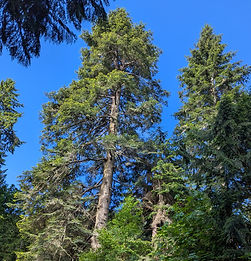
Grand Fir
All pictures taken at the Botanical Garden except where noted


Douglas Fir is the tallest conifer in the Puget Sound forests, with thicker bark than the other trees, making it more fire resistant. Reaching ages of 500 years or more, It creates the initial climax forest. Unfortunately, its seedlings cannot grow in its own shade, and is eventually replaced by Western Hemlocks if the forest is undisturbed for a thousand years.
Grand Fir grows somewhat faster than Douglas Fir, casts its seeds somewhat further, is less fire resistant than Douglas Fir, although more fire and drought resistant than the other Puget Sound Forest trees. Its wood is weaker than Douglas Fir. The 'Dry" forests of the Puget Sound Trough end up being a mix of Douglas and Grand Fir as noted by Arthur Krukeberg.

The dry forest is dominated by Douglas and Grand firs, with Western White Pine common 150 years ago. The Madrone being a common broadleaf tree if within a few miles of the Salish Sea (Puget Sound). Undergrowth tends towards low Oregon Grape and Sword Ferns. Doug firs have stronger wood and are more drought and forest fir resistant than Grand Firs; Grand Firs seed and grow faster than Doug Firs. Western White Pine is more tolerant of water satuarated soils than either of the other two, capable of siting in standing water for up to six months a year, and more drought tolerant than the wet forest woods, Cedar, Hemlock and Sitka Spruce.